Thought exercise: what has been the best customer service experience of your life? What about the worst?
I recently contacted FitBit’s customer service because there were dead pixels on my watch that were making it difficult to read my step count (my main measure of sanity during quarantine). I had already read in the forums that other people experienced the same issue and in each instance a forum moderator directed the customer to reach out directly for a resolution. I was happy to find in my easy 10-minute chat conversation with Janine at FitBit that the resolution meant a replacement watch for me since I was within the one-year warranty. FitBit Customer Service made the process simple, never making me feel at fault, and the new watch was in the mail within 24 hours. Now instead of writing an angry diatribe fueled by my lack of step calculations, I am now singing the praises of a company that values me and my business. So, everyone, go buy a FitBit! #NotAPaidAdvertisement
It used to be that your brand’s reputation had minimal impact – reaching as far as you were willing to travel or send a letter or publish an ad in a newspaper. Now your online reputation can reach as far as the Internet will take it based on a customer service experience, a late delivery, a faulty device, or a misguided marketing campaign. Whether as an individual or a brand, reputation matters more than ever now. And a negative reputation can cost you money: according to a Harvard Business School working paper, a one-star increase in Yelp rating leads to a 5-9 percent increase in revenue.
With the rise of online review systems you can measure your reputation better than ever. On websites like Yelp, TripAdvisor, Google My Business, and Amazon consumers can designate star ratings for businesses and services. On social media consumers can literally ask their followers for recommendations and share their opinions on “must-buys” and “must-avoids”. The speed at which this information is generated and distributed is generally out of your control as a brand, spreading like wildfire. It’s easy to hate these review services for the culture of Review Blackmailers it’s created, but with the right reputation management strategy you can make it clear to all consumers which reviews are authentic and which are not.
I recently read a brilliant piece by Ally Fouts from Viget about how she thinks of “The Mechanics of Reputation.” (Please read the article for a more thought out and beautifully illustrated explanation of this concept. Then let’s geek out about it together!) Ally sees your reputation as a car rolling down a hill with your brand as the steering wheel and your marketing as the gas. Let’s say your online reviews are slowly taking a hit as consumers complain about a recent menu change or a delayed delivery. Their opinion is already out there in the open for the world to see and use to influence their purchasing decisions.
In this situation there are a few ways to manage your brand’s reputation:
Reply to the reviews publicly with an authentic apology (don’t just copy and paste script language) or explanation for the situation to show other consumers that you are at least aware of the situation. It adds context for the future consumer so it isn’t just a one-way conversation of a bad experience.
For larger publicity debacles you can put together a marketing campaign to gain back public trust. An extreme example is Tylenol’s campaign in the 80’s to build back consumer trust after a string of deaths related to poisoned Tylenol capsules.
Meet your consumer before they are emotionally driven to write a negative review. Take a pulse check and resolve issues before they grow.
From the first touchpoint to the last, every inch of your customer’s journey matters in developing your brand’s reputation. Don’t skimp on the details or it could lead to a car wreck at the end with much more costly damage control.
How else do you try to stay ahead of your brand’s reputation?
Job hunting is stressful. Job hunting in the middle of a global pandemic and ailing economy with 1.2 million other people – it can feel like being caught in the middle of a snowstorm without a compass to guide you safely home, doubting every life decision you have ever made up to this overwhelming point.
*deep breath*
After powering through several rounds of applications, interviews, rejections, and ghosting it became harder to maintain confidence and trust in the process (no – not Chris Harrison’s process). I will give credit to my husband for the renaissance I went through when he encouraged me to shift my strategy from sending cold email applications to warm networking requests. Instead of focusing on a singular role that 350 other applicants saw on LinkedIn I connected with contacts who were already in roles I was interested in pursuing. Suddenly it became less about obtaining the short term job and more about my long term career vision.
The four weeks I have spent having informational interviews and coffee chats has already resulted in far more personal fulfillment, inspiring conversations, and exciting contract work than I achieved in the 14 weeks of cold applying. What if I had started with this process from the beginning? Or what if I had been network-focused pre-pandemic? What heights would I have reached today? It has been a humbling reminder that we are all humans after all – not just text on a resume.
As much as companies are working to automate certain parts of society, human connections are still the most important and most beautiful part of life. Despite quarantine we have all proven that we can still overcome barriers to remain connected virtually – even if it requires a few painful texts to coordinate which platform everyone has installed (Are you Team Google Meet or Team Zoom?). As humans we are all going through an immense amount of grief right now – from political disagreements to financial struggles to work/life balance to everything in between. It has amazed me how despite all of this grief just how much compassion we still have available for each other. The number of people who have agreed to speak with me and then connect me with their network and even recommend me for job postings has been unbelievably heartening. Thank you to everyone who has been a part of this journey – past, present, and future. I am honored to be human with all of you right now.
If you’d like to connect – even if we have never spoken before or have not spoken since college graduation – please reach out: mollysharrold [at] gmail.com.
Shout Out to My Favorite Networks:
She+ Geeks Out: I cannot say enough good things about the group of womxn who make up this amazing community. While I miss their in-person events they swiftly shifted to remote events that allow for small group networking, inspirational presentations, and their infamous raffles. More importantly – the conversations continue on a Slack group where people connect from across the country, sharing job postings, asking for introductions, inclusivity resources for the workplace, and more. Check out some of their upcoming events. Let me know if you’d like a virtual buddy!
Lunchclub: This invite-only group opened up my networking to a wide range of open-minded professionals who also see the benefit to connecting. You can choose your goals for connections – like “meet interesting people” or “brainstorm with peers”. Each week you are sent a new introduction and together you schedule a video chat. If you’d like an invite, just let me know!
Alumni Network: I am very grateful for the Northwestern alumni network. The school has made it very easy for us to connect with each other through an internal database. But even on LinkedIn it is helpful to see when a fellow Wildcat already works at the company – or perhaps even founded it. Is your alumni network a bit decentralized? No worries – look for other network groups that could help expand your inner circle, like your national sorority/fraternity or a volunteer group you’ve participated in the past. Now is the time to reach out and ask for a conversation. Don’t be shy!
LinkedIn: LinkedIn has been very valuable when it comes to researching a current company or reconnecting with a classmate working in an industry I am curious about. Premium membership has been helpful for sending InMail, as well, whether to meet someone outside of my current network or to follow up with a recruiter regarding a job posting. Again – don’t be afraid to reach out to anyone that seems appropriate and may be interested in what you have to offer, too.
And of course, Friends & Family Group Chats: You keep me smiling through all of the ups and downs. I can’t wait to embrace you all in the biggest hug.
So every consultant, industry partner, and employee under the age of 30 has said you have to be on Social Media…now what?
There is no denying social media has infiltrated nearly every industry and home across the globe. In fact, the authority it has developed means some users visit a business’s Facebook or Instagram page before their website. For example, 18- to 24-year-olds were twice as likely to check social media before a restaurant’s website. However, having a social media presence is about quality, not quantity. Not all platforms are valuable to all businesses. Let’s take a look at the basics of each platform before you take the plunge and let’s optimize your time.
Facebook
Why do people primarily use it?
Think of Facebook as a personal newspaper, filled with updates from all of the people and businesses you follow. When you log on you can quickly scroll through to find out where your college roommate is traveling to via the “checked in” feature or which of your newly engaged coworkers has a relationship status change. Business pages have cleverly integrated into this news feed with commercial product announcements; municipality messages; and news outlet updates. Users have grown accustomed to seeing personal information directly next to brand information from organizations they’ve chosen to add to their news feed – and lives.
Key Features
–Posts: This is the actual multimedia informational update that falls into a user’s news feed.
–Events: These are a way to highlight an upcoming free or ticketed event that will be announced to your followers and can be publicly available to anyone looking for things to do on a particular date or within your event category.
–Ads: Because of the immense amount of personal data collected by Facebook (for good and for bad), their advertising features allow you to easily target your desired audience. For example, if you have an upcoming jazz concert you would like to advertise, you can tell Facebook to only show the ad to users who have displayed past interest in jazz music and who live within a geographic area that would actually travel to your show. It helps you optimize your ad spend.
–Live Videos: If you would like to engage with your users live – this feature allows you to alert your users that you are speaking live via video where they can comment and engage.
Key Metrics
Whether you are using an external social analytics tool or Facebook’s internal insights, there is ample information available to see how engaging your content is. You can see key metrics such as:
Page Views: number of times a page’s profile has been viewed by logged in and logged out people
Page Likes and Followers: number of new people who’ve liked your page, broken down by organic and paid page likes
Post Reach: number of people who saw any of your posts at least once
Post Engagement: number of times people engaged with your posts through reactions, comments, shares and clicks
Twitter
Why do people primarily use it
Twitter is an open-ended conversation between your brand and the customer. Pew Research calls it, “a modern public square where many voices discuss, debate and share their views.” Users often look to their Twitter feed for the latest news and can interact directly with other accounts. Many companies utilize Twitter as a secondary customer service portal where they can aid customers directly and also monitor any potential negative conversation before it gets out of hand.
Key Features
–Tweet – aka a post; Tweets are limited to 280 characters, though most posts stay well below this limit. You can add images, GIFs, polls, emojis, and links to supplement your text.
–Hashtags – A hashtag is like a searchable keyword that can help other users organically see your post and allow you to appear alongside other relevant conversations. For example, during the Summer Olympics 2016 anyone looking to join the conversation used the official hashtag #Rio2016.
–Trending – On the home page there is a Trending section that tells you what conversations are currently highly active. As well as a personal news source, it gives you a pulse check of what other users are talking about today and whether your brand’s message may or may not be relevant.
–Direct Messages – Think of this as your private Twitter inbox. This is where you can have a private conversation with a Twitter user, perhaps to resolve a customer service issue or exchange contact information.
Key Metrics
Twitter’s internal analytics provides basic information and external platforms like Sprout Social and HootSuite can pull together additional metrics:
Number of Tweets sent from your account over the course of a time period
Tweet Impressions: number of times a tweet appears on a user’s timeline
Followers: number of users who have subscribed to follow your latest posts
Profile Visits: number of users who click through to view your profile page
Retweets: number of times users shared your post with their users
Replies: number of times users directly responded to your post
Likes: number of times users liked your post by clicking the heart
Engagements: Total number of times a user interacted with a Tweet (including retweets, replies, likes, etc.)
Instagram
Why do people primarily use it
Instagram is like a personal magazine or virtual catalogue for your services and goods. This platform is image-focused, so it’s important to only engage here if you have photos or graphics to share. Users come here for inspiration from their favorite influencers and brands more than breaking news, although this line continues to get greyer as social activism comes to Instagram.
Key Features
-Posts: Each post contains a single image or slideshow of images with a caption. One distinctive quirk of Instagram is that you cannot post live hyperlinks to your captions. These posts live permanently within your profile.
-Stories: Instagram accounts can share temporary videos and images to their Stories where they only live for 24 hours. If you want them to live on permanently you can add them to your “Featured Stories” on your profile page, broken down into categories or topics. Many brands use this to show off behind-the-scenes or more organic content versus the polished images within a post.
-Filters: Within Stories, users can add filters to their images. Brands can create sponsored filters for brand awareness purposes. For example, to celebrate a movie premiere the studio may release a filter that allows Instagram users to place themselves into the middle of a scene. The future is here…
-Hashtags: Similar to with Twitter, hashtags are important to Instagram for discovery. As you build your brand’s audience you’ll want to remain a part of relevant conversations and point followers to a custom hashtag to stay a part of your brand’s conversation.
Key Metrics
Follower Growth: My philosophy with any social media account is that the quality of your followers is more important than the quantity. It is more important to have 1,000 highly engaged followers who are more likely to solicit your services than 3M robo-followers who barely interact with your content. That being said, Follower Growth shows that your messages reaching relevant audiences. If it starts to stagnate or decline it’s time to relook at your hashtags and overall content.
Engagements per Follower: This will tell you the percentage of your followers that are actually engaging with your content through likes, comments, and profile clicks. The higher the number the better your content is appealing to your audience.
Reach: Reach is the number of actual views of your content that resulted in an engagement of some kind. Impressions, on the other hands, indicates views that may not have resulted in any kind of engagement.
Stories Engagement: This is how you will know how many people are actually watching your Stories. Users can engage with stories via messages. Important metrics here will be whether a user watched the entire story or exited after the first slide.
TikTok
Why do people primarily use it
TikTok is the latest viral video platform that has especially grown in popularity during Quarantine with nearly 1 billion monthly active users across the globe. As soon as users open the app they are immediately thrown into an endless stream of video clips, like a personalized television station – similar to the Facebook and Instagram Stories feature. Videos are 15-60 seconds and the content is everything from family dance videos to fun facts about snails to adorable cooking demonstrations. There is a lot of potential for brands to get creative with their voice on this channel.
Key Features
–Videos: Your 15-60 second video can be something filmed or a compilation of photos stitched together. These appear in the “For You” feed and showed to relevant users who may engage with your content based on their past engagement with similar accounts. Users can watch your video as many times as they like.
–User Profiles: This is where your videos live permanently. Users can visit your profile to see all of your content in one place.
-Templates: If you want to turn multiple photos into a video, these TikTok-created Templates help stitch your photos together with preset effects, including sounds.
-Sounds: Part of the virality of TikTok is the music used in the videos. Some artists are hitting the top of the charts because their songs are used on the platform. There is an entire library of music now available to include in your video, including categories like Trending, Memes, and Dance. Click here to listen to the “TikTok Trending” playlist on Spotify for a taste of what is currently popular.
-Effects: The TikTok effects are very similar to the filters on Instagram, allowing for augmented reality experiences and interactive features.
Key Metrics
Since TikTok is more about discovery and brand awareness for the audience, these are likely the three most important metrics to measure:
Video Views: How many times users viewed each of your posted videos.
Followers: How many users saw one of your videos and decided to follow your account so they can easily see your future posts.
Profile Visits: How many users clicked through from a video to see your profile and the rest of the content you have created as well as a short description of who you are.
YouTube
Why do people primarily use it
YouTube is the second largest search engine after Google, so the uses for YouTube are endless. Users utilize the search function to learn new skills, find the answer to a problem, and purely be entertained. Brands can upload videos with product demonstrations, reviews from partners, or live stream events. Even television shows, like The Tonight Show starring Jimmy Fallon, upload entire episodes to YouTube now so the show lives on past its live network broadcasts.
Key Features
–Video Life: Once you upload a video to your channel, it will live there forever and be searchable by all users, unlike other social media accounts where your content disappears quickly from the feed.
–Video Length: The length of videos on YouTube are significantly longer than other channels. Default videos can be 15 minutes. Once your account is verified you can upload videos up to 128 GB or 12 hours.
–Playlists: You can curate your videos into playlists to help guide users to a particular topic.
–Monetization: Once your channel reaches 4,000 public watch hours in the last 12 months, and 1,000 subscribers, you can earn money from your YouTube channel, such as ad revenue, channel memberships, merchandise shelf, and more.
Key Metrics
Watch Time: Total amount of minutes users have watched your videos
Average Percentage Viewed: Percent of each video the average user watched
Average View Duration: Total watch time of your video divided by the total number of video plays
Audience Retention: Percentage of users who watch and leave your video at any time during the video
Engagement: Measures the number of comments, shares, likes, and dislikes your videos receive
Subscriber Growth: Number of users who decide to follow your channel so they are alerted when you upload new content
LinkedIn
Why do people primarily use it
Think of LinkedIn as Facebook for your professional persona. Users can post their personal accomplishments and companies can share new job postings and updates to attract new talent. Users follow brands they are interested in and connect with other users for networking purposes.
Key Features
–Posts: Users and brands can post a variety of content to the news feed, including photos, videos, documents, and articles. There’s a chance you’re reading this very article because you saw my LinkedIn post!
–Groups: Users can join public and private groups that allow them to network and communicate with other similar professionals, alumni, and more.
–Jobs: As a brand you can post available positions that will appear in the news feed of anyone following your company or has relevant work experience that could be a match. Your current employees can also share these postings with their networks.
–Messaging: With this feature users can communicate with each other directly for networking and/or recruiting purposes.
–Company Profiles: Here you can create your brand’s presence through a cover photo, logo, an about section, and more. Your current employees will also be visible so users can learn more about possible connections and how large the company is. This is also where you can compile all of your current job postings.
–Advertising: The amount of data available from all of the user profiles allows brands to create campaigns for brand awareness, engagement, job applicants, and lead generation.
Key Metrics
Engagement: Similar to the other social media platforms, this measures the number of comments, likes, link clicks, etc. your posts have received.
Website Traffic: By looking at your Google Analytics account attached to your website, you can see how many users are visiting your website via LinkedIn.
Page Followers: This number tells you how many people have chosen to follow your page for future updates – either as an employer or potential business partner.
Lead Generations: This is easier to measure if you run an ad to specifically collect new leads, but you can still manually track leads that arrive from LinkedIn to help measure the success of your company page.
Snapchat
Why do people primarily use it
Compared to all of the other channels, Snapchat is typically a private channel between only close contacts. Users can send messages, images, and videos to each other that can only be viewed once before they disappear. There are public Snapchat channels that brands have created to curate news and information, but the feature has reduced in popularity when Instagram unveiled its own Stories section.
Key Features
–Friends Map: Users can choose to make their location available to their followers which is visualized as a Bitmoji on a world map. If you are currently flying or on a boat, the Bitmoji will even show this, too!
–Chat: This is where users can send temporary messages to each other either via text, photo, or video. Chat messages disappear after they are viewed. If a user takes a screenshot, the sender receives an alert.
–Stories: If a user wants content made public to all of their followers for 24 hours, they can add it to their Stories section. Users can also share these with local stories for the general public to scroll through – such as a Chicago Story.
-Lenses: Similar to the filters and lenses mentioned in Instagram, users can augment their photos and videos with interactive lenses. Brands can utilize these, as well. For example, right now users can interact with the NBA filter that allow them to scroll to their favorite team and it will look like they’re wearing their team’s jersey.
-Discovery: Here users can watch a compilation of videos curated by brands such as People, SNL, Vulture, and more.
Key Metrics
Unique Views: Unique views are the total number of users who watched at least one second of your content.
View Time: This tells you overall how much time users are spending viewing your content.
Completion Rate: This metric tells you how many viewers watched your content from start to finish. This helps you understand if your content is engaging or not.
Screenshots: Since content is temporary on Snapchat, engagement is measured by how many users screenshot your content. This means they want to save it for later or share with their own friends.
Geofilter Metrics: Measures how many times users have used your custom geofilter on their own images. These are often used to promote location-based events or a single day event.
Pinterest is where users go to get inspired in a multitude of categories in the form of pins, which are image cards in your news feed. Mixed into the organic content are sponsored pins from brands that naturally fit into the content flow. Users can save pins to private or public boards and refer to later or share with friends. Brands can also create their own boards to showcase products or things that inspire their organization.
Key Features
–Pins: Included in a pin is an image, a title, a brief description, and an optional link to an external website. Users can then save your pin to their boards, share, and comment on it.
-Search: The search bar allows users to search for pins, such as bridal updo ideas, paleo recipes, or first birthday party themes.
-Boards: Users and brands can create private and public boards where they collect pins from a variety of creators into one convenient location. These can be shared with other users for collaboration, as well.
Key Metrics
Impressions: total number of times your pins were shown in a user’s news feed
Engagements: total number of saves, closeups, link clicks, and carousel card swipes on your pins
Closeups: total number of times people viewed a close-up version of your pins
Saves: total number of times people saved your pins to a board
Link Clicks: total number of times people have clicked on your pins to an external website
DEMOGRAPHICS BREAKDOWN
Let me know what questions you have in the comments below. What other information would you find helpful? Are there other platforms you are curious about?
Great question! Social media can be a fun, organic way to engage with your customers directly but it can also be overwhelming as new platforms emerge each year. How do you know where to begin? I’m here to help jumpstart your brand’s presence on the channel(s) that make the most sense for you. Have more questions? Let me know in the comments below!
1. What is the best platform to start with?
Before you choose a platform, it’s more important to answer these key questions:
Who is your target audience?
What type of content do you have to share? Is your content mainly visual? Is it text-based? Will you need to show live videos regularly?
What will your call-to-actions be for your audience? Is your goal to send them to your website to download a white paper? Is it to purchase your consumer good? Is it to call your restaurant for directions?
Identifying your key goals for interacting with your audience will then direct you to the appropriate social media platform. For example, if your goal is to recruit new entry-level employees for your business you likely already know the importance of LinkedIn but may not be aware of Facebook’s Jobs feature. If your goal is brand awareness for a consumer good, you may be less interested in text-heavy Tumblr or Medium for blog posts but may gain more attention from your professional photography and videos on Instagram, Pinterest, and YouTube.
I’ll be breaking down each social media platform more specifically in an upcoming post. Stay tuned!
2. How often do you really have to post?
Ah, yes. The magical question. How often you post depends on your goals and the platform. Ideally you should aim for staying in user’s feeds at least once per week. This will help the platform’s algorithms prioritize your account and increase the chances of putting your message in front of user’s when they are about to make a decision that applies to your business.
If your content is largely text-focused, like blog posts on Medium or Tumblr, you can safely stay at once per week because you have invested so much time in the piece. You can supplement it by sharing it to your Facebook or LinkedIn feed twice that same week to remind users what they may have missed on your other accounts. Remember: not every post has to be brand new original content. I’ll explain more below.
3. How do you keep posts interesting and engaging if you’re posting a lot?
Ask yourself, “What would I want to see in my social media feeds?” Is there a relevant trend that you could attach your brand to that would make sense for your product/organization/service?
It is also useful to think ahead with an editorial calendar. Pick a few essential dates where you should be the leading voice on your social media channels and start to plan around these. For example, if you offer car washing services you should amplify your voice on your channels once the weather in your target geographic area is ideal for a car detail and wash. If you are a nonprofit with semi-annual fundraiser goals, your calendar will build off supporting this campaign and allow you to then work backwards with supplemental content.
Another approach is choosing a few key categories of posts that you rotate between throughout the month to approach your brand from different angles. This will help the content appear fresh and diverse even if you are recycling portions of your messages. Some category examples include:
Informational: posts that provide facts about your product, organization, employees, etc. – content that would typically be FAQs
Inspirational: posts that inspire your target audience to trust your content and be in the mindset to want your services or product – like recent press, a recent positive review, fun trivia, or a beautiful image
Promotional: posts about active and upcoming marketing initiatives, like sales, new product launches, fundraising goals, etc. – the perfect time to share a direct call-to-action
Engaging: posts that create emotion for your target audience – either through a photo, quote, video, poll, etc. – the goal is to have them actively engage with the post through a reaction or comment
4. How do you reach people without paying?
Narrow in on who you are trying to reach and brainstorm where they are spending their time with organic content. Look for Facebook groups, Reddit forums, and blogs where your target audience spends time and wait for organic ways to engage with them and observe the resources they are sharing with each other and the hashtags they are using. Then you can implement common keywords in your own content; copy the hashtags in social media campaigns; or find brand ambassadors that may be open to publicizing your brand in exchange for product or your services.
Important Note: DO NOT approach forums and groups where you can be interpreted as spam. Nobody likes spam (although I acknowledge that some people like Spam – no judgment).
5. Social media doesn’t really interest me as a producer of content. How do I get excited about it?
Unfortunately I don’t have a magical answer for this one…but I’m personally addicted to watching the engagement. I love thinking, “What will people love to see or learn today?” But also think, “What would I want to see?” Do not worry about starting from scratch every time you create a post – build up a library of photos and videos. Graphics are also super easy to build now thanks to free tools like Canva. Maybe there’s a local photography student building their portfolio that would be willing to produce content for you to help build out their personal portfolio. Once you have a robust library you can recycle photos and videos continuously but paired with new copy.
Another wonderful thing you can do is share other people’s content (with credit of course!). Perhaps a recent customer tagged you in a photo of them in your restaurant. You can share the photo, add your own commentary to the post, and tag the customer’s handle. This is called User Generated Content and is often my favorite type of content because it’s authentic and perhaps a different view than you would typically take.
So with perhaps the most attentive online audience in human history, every consumer-facing brand has had to make a hard pivot on their communications strategies, especially on social media where the comments can be blunt and the share function lethal. I am continually impressed by the agility and creativity of companies both local and international who have quickly adapted their product and/or focused their messaging toward awareness and aiding those in need.
Below are some of my favorite examples from the last few weeks. Who have you noticed leading the pack on social media? Please share!
Toast – Restaurant POS Tech Company based in Boston
As soon as state governments began ordering the closure of all non-essential businesses, the restaurant industry was one of the first and hardest hit. With their entire client base at risk, Toast quickly took action through Instagram, Facebook and LinkedIn with a call to #RallyForRestaurants. They developed this separate hashtag campaign and social media persona for the initiative, encouraging their followers to support their favorite restaurants through online ordering and/or gift card purchases, which the Toast platform supports. This also encouraged the restaurants to participate with a personal spin on their social media accounts. The hashtag is used in 5000+ posts on Instagram as of publishing, and the branded Facebook and Instagram pages have 2500+ followers.
marlo marketing – Full-Service Integrated Marketing and Creative Agency based in Boston and NYC
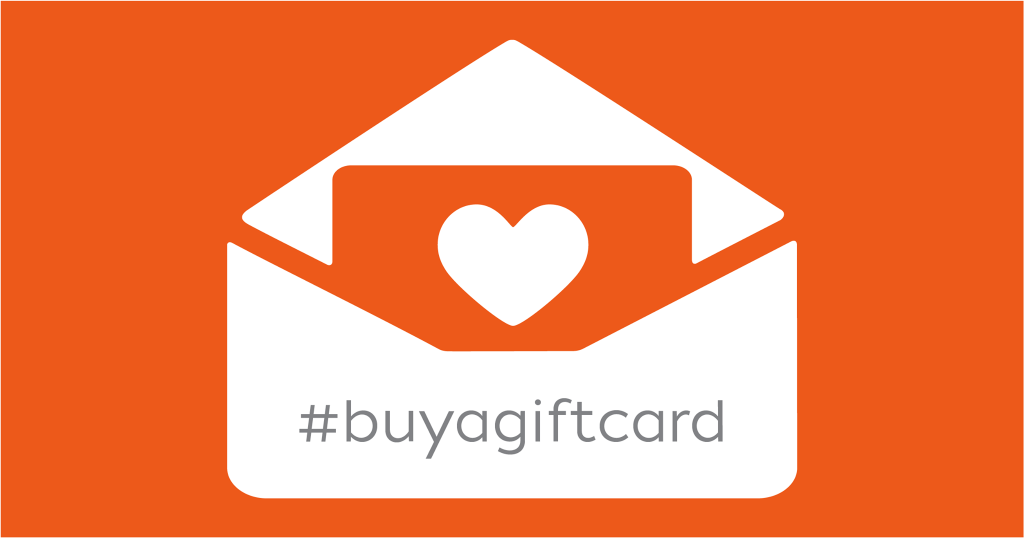
In a similar vein, marlo marketing is a marketing agency with numerous hospitality clients who were quickly faced with a depleted customer base and little to no revenue. Within hours of the quarantine announcements in Boston, marlo started a #BuyAGiftCard campaign across Instagram, Facebook, Twitter, and LinkedIn with easy-to-share graphics and another easy and consistent call-to-action for both restaurants and customers alike to share their recent purchases. Taking it a step further, Marlo Fogelman herself is leading an online discussion on May 7 at 1pm about the state of the Boston restaurant industry and what reopening may look like.
On the entertainment side, talk show hosts across the globe were ripped away from their live audiences and production crews. We have all quickly become intimate with other people’s homes on endless video calls, including our favorite late night entertainers. Jimmy Fallon’s At Home Edition of The Tonight Show on YouTube literally hits home for every working parent right now. While his wife Nancy films, Jimmy delivers his monologue from the playroom while their daughters, Winnie (6) and Franny (5), waiver between helping and distracting their parents. The result is a series of charming mini-episodes with other celebrities popping in via video chat to share their own attempts at homeschooling, cooking, crafting, and more. In addition to lifting the viewer’s spirits, each episode is also dedicated to a charity. While viewing the episode on YouTube, the user can click a “DONATE” button on the website that is associated with the charity of the day. Unlike television where the viewer has to elect to pick up their phone or computer to participate in a donation, keeping the content and donation information on the same platform and/or device likely increases the likelihood of engagement. So far The Tonight Show has raised more than $22k for City Harvest, $25k for #SaveWithStories, $55k for Feeding America, and several other charities.
To all of the couples who were to say, “I do,” in 2020: I am so sorry. And to the entire wedding and event-planning industry, I am also so sorry. Couples have quickly changed course – either eloping to city hall; holding wedding ceremonies with friends and family watching from afar in their cars; or postponing altogether. Vendors also changed strategy from sharing blissful social media content to pure crisis management. Hayley Paige, a wedding dress designer who is known for her bubbly personality and body positive messaging, adapted her content on Instagram to help brides through the difficult decision making. She hosted an Instagram Live Q&A session to talk about things like how to preserve a gown during a postponement and created a guide for how to take dress measurements at home since most tailors are closed. A Practical Wedding, a wedding planning guide known for down-to-earth advice, also welcomingly adapted their content – sharing photos of recently married couples and how they still made their wedding day special without anyone present; sassy ways to announce a change of wedding date; and how to throw a virtual bachelorette party or bridal shower.
Food & Beverage Personalities
One of the best things to come from shelter-in-place orders has been free cooking classes with some of the most talented chefs and bartenders across the globe on Instagram. Some of my favorites have included:
Tara Jensen, author of A Baking Year (@bakerhands), leads followers through a day-by-day guide to creating your own sourdough starter in her highlights, including recipe recommendations to help use your sourdough discard. Bonus content: photos of her very newly born daughter, Violet Rye.
Sam Treadway of Backbar in Somerville, MA (@backbar) posts demos of the bar’s classic cocktails, providing hints for how to create them with the supplies you have at home or links to the vendors they use for things like aromatic bitters. New this week are custom mixers you can order for pick up from their Union Square location, in addition to new coupe glasses so you can show off your own creations on Instagram.
Christina Tosi of Milkbar (@christinatosi) is known for creating Willy Wonka-esque sweet treats that have people lining up around the block at bakeries across the U.S. and Canada. Christina uses Instagram to bring the bake shop directly to you with her #bakeclub. Each day she posts a picture of the ingredients she will be using in her class, leaving much suspense for what she will be cooking with you later on Instagram Live with more than 32k other followers.
Stephanie Izard of Girl and the Goat (@stephanieizard) is here for those with more of a savory craving. While she is not cooking for Instagram daily, Stephanie regularly shares tips for home chefs in general – like how to order fish at the market and ways to grill stand out chicken. Look for recipes in her stories or highlights.
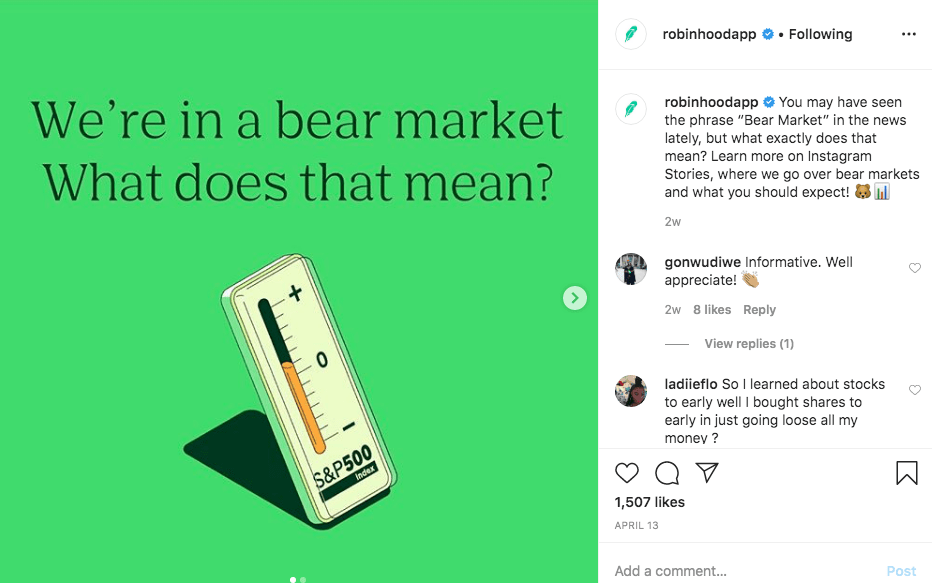
The news has not been comforting in regards to the stock market (or much else, to be honest), including unheard of negative oil prices and talk of a potential recession. Robinhood is an app trying to “democratize the financial system” through education and commission-free trading. They are utilizing Instagram to continue this mission by defining terms from the news in attractive infographics and baseline recommendations for how to manage investments when some industries are tanking while others are flourishing.
Chicago Mayor Lori Lightfoot – #StayHomeSaveLives
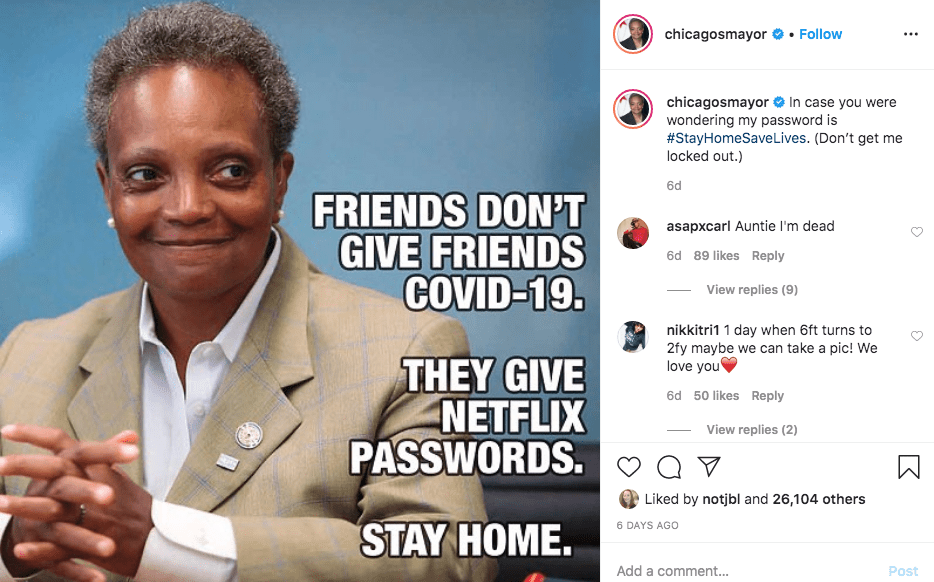
In what may be my favorite example of civic leadership through social media, please meet Chicago Mayor Lori Lightfoot. I may be biased due to my 26 year history in Chicago, but, regretfully, I was not there to elect her. She is using the power of memes to spread the important message to stay home. When St. Patrick’s Day weekend resulted in crowded Chicago bars and the next week’s beautiful spring weather beckoned citizens to the city’s lakefront park, Mayor Lightfoot became “delightfully strict.” There were the usual press conferences with Governor J.B. Pritzker, but she also put a creative twist on her message through Facebook, Instagram, and Twitter to reach the constituents who were probably skipping the nightly news. Her kickoff message was a 2:49 Facebook video explaining over and over in several different personas (The Baller, The Astrologer, etc.) how to “Stay Home. Save Lives,” which currently sits at 1.4M views and has received 28k reactions. One week later she partnered with every professional Chicago sports team for a Facebook Live video shot from the middle of an empty Soldiers Field with the message, “We are Not Playing…and Neither Should You.” This was followed by a coordinated organic social media campaign with each team on Twitter, Facebook, and Instagram, reaching their larger network of millions of fans.
Who have you noticed using social media in a creative or positive way during COVID-19?











 Molly S Harrold